What Is Demodex? Understanding Eyelash Mites and Demodex Blepharitis

Many people notice floaters or flashes of light in their vision at some point in their lives. While these symptoms are often harmless and part of normal ageing changes inside the eye, they can occasionally signal a more serious problem that needs urgent attention.
Understanding what floaters and flashes are, and when they require an eye examination, can help protect your vision.
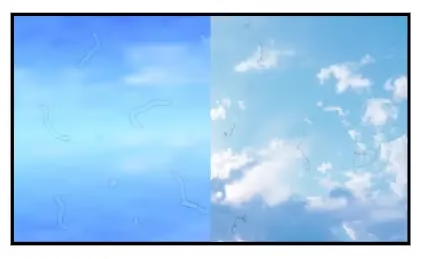
Floaters appear as small shapes drifting across your field of vision. People often describe them as:
They are usually most noticeable when looking at a bright background, such as a clear sky or a white computer screen.

Floaters occur when tiny clumps form within the vitreous, the gel-like substance that fills the inside of the eye. As light passes through the eye, these clumps cast small shadows on the retina, which we perceive as floaters.
As we get older, the vitreous naturally becomes more liquid and can shrink slightly. This process is called a posterior vitreous detachment (PVD) and is one of the most common causes of floaters.
Flashes are brief bursts or streaks of light that appear in the peripheral vision. Some people describe them as:
Flashes occur when the vitreous gel pulls or tugs on the retina. The retina interprets this mechanical stimulation as light, even though no light has actually entered the eye.
Like floaters, flashes often occur during normal vitreous changes with age.
Occasional floaters that have been present for a long time and remain stable are usually harmless.
Many people develop floaters as part of the natural ageing process, particularly after the age of 40–50. They may become more noticeable during a posterior vitreous detachment and then gradually settle over time.
Although most floaters and flashes are benign, sudden changes should never be ignored.
You should seek prompt assessment if you notice:
These symptoms may indicate a retinal tear or retinal detachment, which require urgent treatment to prevent permanent vision loss.
Some people are more likely to develop retinal tears or complications related to floaters and flashes. Risk factors include:
If you fall into one of these groups, it is particularly important to have new symptoms assessed quickly.
If you present with new floaters or flashes, your eye specialist will perform a dilated retinal examination. This involves using eye drops to widen the pupil so the retina can be examined thoroughly. Your specialist may also use ocular imaging, such as optical coherence tomography (OCT) or fundus photography, to capture detailed images of the retina for closer evaluation.
In many cases, no serious problem is found, and reassurance and monitoring are all that is required. However, if a retinal tear or detachment is detected, prompt treatment is necessary. This may include laser therapy, cryotherapy (freezing), or surgery to repair the retina and prevent vision loss.
Floaters and flashes are common and are often a normal part of ageing changes inside the eye. However, sudden onset or rapid changes should always be checked.
Early detection of retinal problems allows treatment before vision is permanently affected.
If you experience new floaters, flashes, or any change in your vision, arranging a prompt eye examination is the safest step.