How Reliable Is a Visual Field Test?

For years, conversations about screens and eye health have focused heavily on blue light. Parents are often reassured by blue light glasses, screen filters and ‘night mode’ settings, but these solutions can distract from the more important issue: the impact of screen use on tear film stability, sleep disruption, and the development of dry eye symptoms.
The growing rise in dry eye symptoms in children, teenagers and young adults is less about the light emitted from devices and more about prolonged screen use, reduced blinking, inadequate sleep and the physical strain that comes with spending hours focused on near tasks.
Screens are now part of everyday life. They are how we learn, work, socialise and relax. The goal is not to eliminate screens, but to understand how prolonged and uninterrupted use can affect the eyes, and what simple habits can help reduce symptoms.
Traditionally, dry eye disease was considered something that mainly affected older adults, particularly post-menopausal women. Today, eye care professionals are seeing symptoms much earlier.
Children, teenagers and young adults are increasingly presenting with:
Whether someone is gaming, studying, scrolling, editing documents or working across multiple monitors, long periods of uninterrupted screen use can disrupt normal blinking patterns and increase tear evaporation, placing significant stress on the surface of the eyes and contributing to dry eye symptoms.
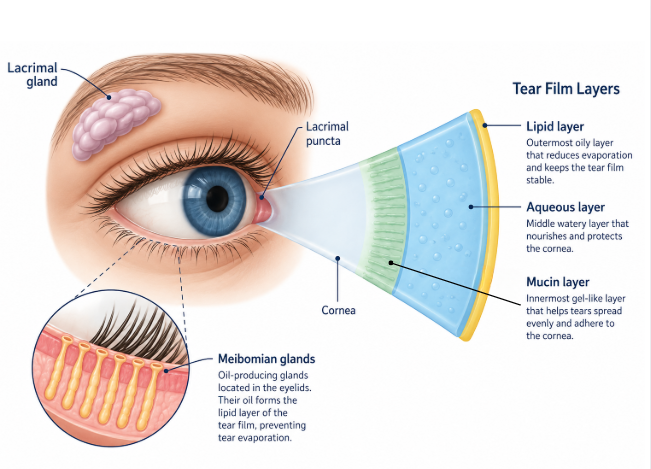
A healthy tear film depends on regular, complete blinking. Every blink spreads fresh tears across the surface of the eye and helps release oils from the meibomian glands within the eyelids. These oils slow tear evaporation and stabilise the tear film.
Under normal relaxed conditions, humans blink frequently and fully. But when concentrating on screens, blink rates can reduce significantly. Even more importantly, many blinks become incomplete or partial blinks.
A partial blink occurs when the eyelids do not fully meet. This means the tear film is not properly redistributed and the oil glands are not adequately compressed to release protective oils. Over time, this contributes to tear evaporation, irritation and dry eye symptoms.
Some clinicians suggest a simple “double blink” strategy: an initial blink followed by a conscious full blink to ensure the lids fully close and the tear film is properly refreshed.
For many screen users, this small adjustment can significantly improve comfort.
Another often overlooked factor is sleep. While screens are not inherently harmful to the eyes, modern usage patterns often push bedtime later, reducing both sleep quality and duration.
Children and teenagers may stay up gaming, messaging, scrolling, streaming or studying, while adults often move directly from work screens into evening screen time. This matters because the ocular surface depends on sleep for recovery. When sleep is reduced, people commonly experience increased eye irritation, poorer tear stability, heavier eyelids, greater light sensitivity and reduced visual endurance.
In this way, screens can act as a “thief of sleep,” and the downstream effects of poor sleep may be just as significant as screen exposure itself in the development and worsening of dry eye symptoms.
How we use screens physically also influences ocular comfort. Many people spend long periods leaning forward, using screens positioned too high, or working from laptops in non-ideal setups. This can contribute to neck and shoulder tension, headaches and facial fatigue
Screen setup matters more than many realise. A more comfortable arrangement generally includes a screen at approximately arm’s length, slightly below eye level, with a neutral sitting posture.
Uncorrected or under-corrected vision can significantly increase visual demand during prolonged near tasks. Even small refractive errors such as mild long-sightedness, astigmatism or early age-related focusing changes (presbyopia) can lead to sustained visual effort during screen use.
People often compensate unconsciously by squinting, leaning closer, or pushing through visual discomfort, which increases fatigue over time. Appropriate optical correction can reduce unnecessary strain and improve comfort, particularly in middle aged adults where early presbyopic changes are common.
Dry eye is rarely driven by a single factor, and lifestyle plays an important role. Simple measures such as maintaining good hydration, ensuring adequate sleep, supporting nutrition and avoiding prolonged uninterrupted screen sessions all contribute to tear film stability and ocular comfort.
The eyes function best when the body is well supported. In many cases, what is attributed to “screen use” is actually a combination of reduced blinking, sustained concentration and insufficient recovery time between visual tasks.
Screens are not going away – nor should they.
Technology is essential for education, communication, work and entertainment. The conversation should move away from fear-based messaging and toward healthier screen habits. Understanding blinking, sleep, posture, visual strain and overall wellbeing provides a far more meaningful approach to eye comfort than focusing solely on blue light exposure.
The human eye was designed with sophisticated protective mechanisms. Sometimes, supporting eye health is less about expensive products and more about allowing those natural systems – blinking, rest, hydration and recovery – to do what they are meant to do.

Copyright © 2023 Nexus Eye Care | Trans4m Business Consulting – Website Design & SEO | Privacy Policy | ^