If you’ve ever had a visual field test, you may have walked away thinking: “I don’t think I did very well.”
You’re not alone. One of the most common concerns patients have is that they missed lights, reacted too slowly, or weren’t sure whether they pressed the button at the right time.
The reassuring news is: the test is designed with that in mind!
A visual field test measures your peripheral (side) vision – the areas of vision you don’t notice when you’re looking straight ahead.
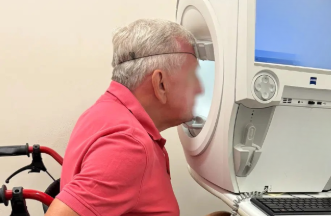
During the test, you’ll focus on a central target while small flashes of light appear in different locations and at different brightness levels. Some lights are easy to see, while others are intentionally very dim. Each time you see a light, you simply press the button.
Sounds easy, right?
In reality, it’s not. The lights appear unpredictably, some are only just visible, and it’s completely normal to wonder if you missed one. Many patients worry they’re blinking at the wrong time, reacting too slowly, or pressing the button incorrectly.
Unlike a standard eye chart, a visual field test creates a detailed map of how well you detect light across your entire field of vision, helping your ophthalmologist identify subtle changes that you may not notice in everyday life.
Modern visual field machines are incredibly sophisticated. They don’t simply count how many times you press the button – they also assess how consistent your responses are throughout the test.
Built-in reliability checks include:
This gives your ophthalmologist valuable context when interpreting the results, rather than relying on a single missed response. Your ophthalmologist is assessing your visual field – not your performance.
Yes, please blink!
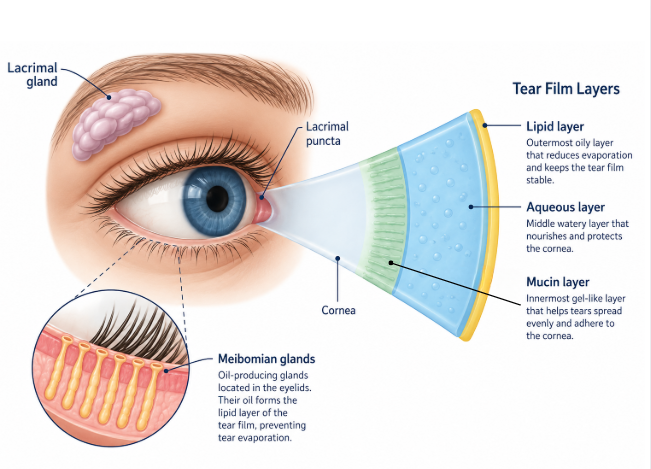
Many patients worry they’ll ruin the test if they blink, so they try not to blink at all. In reality, blinking is completely normal and helps keep the surface of your eye comfortable.
Trying not to blink can actually make the test more difficult. As your eyes dry out, they may start to water, causing tearing and blurred vision that can make the lights harder to see.
If you happen to blink and miss a light, don’t panic. The test is designed with natural blinking and normal human variation in mind, so an occasional blink or missed light won’t invalidate the test.
A visual field test measures the function of your optic nerve – the nerve that carries visual information from your eye to your brain. When the optic nerve is damaged, it can create areas of missing or reduced peripheral vision known as visual field loss.
Visual field testing is one of the most valuable tools for detecting and monitoring conditions such as:
Importantly, a visual field test is not used in isolation to make a diagnosis. Your ophthalmologist combines the results with your symptoms, eye examination, optic nerve assessment, OCT scans, eye pressure (when relevant), and other clinical findings to build a complete picture of your eye health.
A visual field test isn’t a pass-or-fail exam. It’s one of the most clever tests in ophthalmology, providing detailed information that helps your ophthalmologist detect subtle changes, monitor disease progression, and protect your vision over time.
So, if you leave the test thinking, “I definitely missed a few lights,” you’re probably in good company. The test isn’t measuring how perfect your reactions are – it’s measuring your peripheral vision.
Most visual field tests take around 5 minutes per eye, depending on the type of test being performed. The test is painless, and you’ll be given instructions before it begins so you know exactly what to expect.
No. There is no age limit for visual field testing. While the test can become more challenging as we get older, it is designed to account for normal variations in concentration and reaction time. If you’re able to follow the instructions and press the button when you see a light, the test can usually provide valuable information.
Many eye conditions (especially glaucoma) change gradually. Having regular visual field tests allows your ophthalmologist to compare your results over time and detect even small changes in your peripheral vision. Looking at trends across multiple tests is often more informative than a single result.
No.
A visual field test is an important tool for detecting and monitoring glaucoma, but it is only one piece of the puzzle. Your ophthalmologist also considers your optic nerve appearance, OCT scans, eye pressure, and your overall eye examination before making a diagnosis.
Further reading: Understanding Eye Pressure Numbers: What Do They Actually Mean?
Copyright © 2023 Nexus Eye Care | Trans4m Business Consulting – Website Design & SEO | Privacy Policy | ^