What Is Demodex? Understanding Eyelash Mites and Demodex Blepharitis
Low-Level Light Therapy (LLLT) is a non-invasive treatment used in the management of Meibomian Gland Dysfunction (MGD) and evaporative dry eye.
Understanding how LLLT works, what the treatment involves, and what results you can realistically expect will help you make informed decisions about your dry eye management.
Healthy vision depends on a stable tear film. Dry eye is a common but often overlooked condition that can occur when the tears are unable to adequately lubricate and protect the surface of the eye.
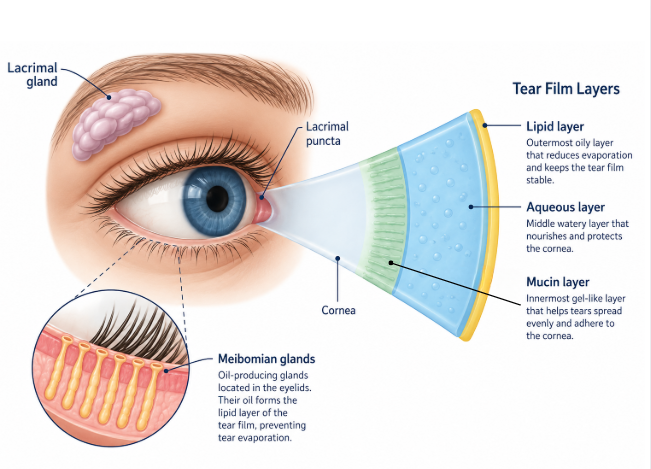
Although we often think of tears as simply “water,” they are actually made up of three important layers:
The outer oily layer is produced by tiny oil glands located within the eyelids called the meibomian glands.
When these glands become blocked or stop functioning properly, a condition known as Meibomian Gland Dysfunction (MGD), the oily layer becomes thinner or poorer in quality. As a result, tears evaporate too quickly, leading to symptoms such as:
Interestingly, watery eyes can also be a symptom of dry eye, as the eyes may produce excess watery tears in response to irritation.
Because MGD is one of the most common causes of dry eye disease, improving the function of these glands is an important part of treatment.
Low-Level Light Therapy, also known as photobiomodulation, is a gentle, non-invasive treatment that uses specific wavelengths of red and near-infrared light to improve the health and function of the meibomian glands.
Unlike treatments that simply provide temporary symptom relief, LLLT aims to improve the health of the eyelids and support healthier gland function over time.
The treatment is painless, requires no downtime and is designed to reduce inflammation while stimulating the cells responsible for maintaining healthy eyelid tissues.
LLLT works at a cellular level.
The light is absorbed by tiny structures inside your cells called mitochondria, often referred to as the “powerhouses” of the cell.
This stimulates the production of ATP (adenosine triphosphate) – the energy source cells use to repair themselves and function efficiently.
As cellular energy increases, a number of beneficial changes occur:
Rather than physically “melting” blocked oils, LLLT improves the health of the cells that support your meibomian glands, allowing them to function more effectively.
The recommended treatment consists of 3–4 LLLT sessions, usually performed one week apart. This schedule is designed to provide repeated stimulation of the cells within the eyelids, allowing the therapeutic effects to build over time.
Unlike treatments that produce an immediate mechanical effect, LLLT works by stimulating cellular repair and reducing inflammation. Each treatment increases cellular activity and supports tissue healing. Repeating the treatment at regular intervals reinforces these processes, allowing the effects to accumulate with each session. This cumulative response is one of the key reasons why multiple treatments are recommended.
Meibomian Gland Dysfunction is a chronic condition that develops over time, and improving gland function is also a gradual process. Completing the recommended course of treatment gives your meibomian glands the best opportunity to recover, improve the quality of the oils they produce, and contribute to a more stable tear film.
During the procedure, the treatment mask is positioned over your closed eyelids. The treatment usually takes around 15–20 minutes.
Most patients describe it as:
There are no injections, no bright flashes of light and no recovery period afterwards. Many patients simply close their eyes and relax during the treatment.
Because LLLT works by stimulating gradual biological changes, it is uncommon for patients to experience dramatic improvement after the first treatment. Most patients begin noticing improvements after the second or third treatment, although some people improve earlier and others not until they have completed the full course.
The improvements are usually gradual rather than dramatic. Patients commonly report:
LLLT doesn’t replace every aspect of dry eye treatment. Instead, it becomes part of a broader management plan. Managing dry eye is also particularly important for patients preparing for cataract surgery, as the condition can affect the ocular surface before and after the cataract procedure.
Artificial tears eye drops provide immediate moisture and protection for the surface of the eye, while LLLT works more slowly by improving the health and function of your meibomian glands.
In many patients, we use LLLT together with lubricating eye drops and other treatments to bring the dry eye under control.
As the ocular surface becomes healthier and your symptoms improve, we may then be able to gradually reduce other treatments, such as decreasing how often you use lubricating eye drops.
The goal is not to stop treatment overnight, but to simplify your treatment plan where possible while maintaining comfortable, healthy eyes.
Not noticing an improvement after four treatments doesn’t necessarily mean the treatment hasn’t worked. Dry eye disease is complex, and symptoms don’t always match what we see during an eye examination.
Sometimes the meibomian glands have improved, and the tear film has become more stable, but another condition is continuing to cause symptoms. This may include:
If you don’t experience the improvement you were hoping for, your eye care practitioner will reassess your eyes rather than simply continuing the same treatment indefinitely.
Like many treatments that work by encouraging the body’s natural repair processes, LLLT requires commitment to the recommended course of therapy. It is not a one-off treatment, and the benefits develop gradually through repeated stimulation of cellular repair processes. Completing the recommended treatment course gives your meibomian glands the best opportunity to respond and improve over time.
LLLT is not a standalone cure for dry eye, but rather one part of a comprehensive treatment approach. In many patients, it is combined with lubricating eye drops, eyelid care and other therapies to help bring dry eye under control.
As your eyes become healthier and symptoms improve, your treatment plan can often be simplified where appropriate. However, the overall goal remains the same: improving comfort, maintaining a stable tear film and helping you achieve long-term eye health.
LLLT is most commonly recommended for people with Meibomian Gland Dysfunction (MGD) and evaporative dry eye. A comprehensive dry eye assessment is needed to determine whether it is the most appropriate treatment for your condition.
Yes.
LLLT is not suitable for everyone. It may not be recommended if you are taking photosensitising medications, have certain light-sensitive medical conditions, or have an active skin infection or open wound around the treatment area. Your ophthalmologist will review your medical history and medications to ensure the treatment is safe for you before proceeding.
Copyright © 2023 Nexus Eye Care | Trans4m Business Consulting – Website Design & SEO | Privacy Policy | ^